Archpriest Alexander F. C. Webster, PhD
[Webster lecture and discussion: “War & Peace in Our Time: Three Moral and Ethical Options” at GMU Spiritual & Interfaith Center Nov., 13, 2025]
* See the end of this article for the two charts cited in the text.
Before I begin my presentation today, I must thank our sponsor, the “Voices at the Center” program here at GMU, and our host, the Spiritual and Interfaith Center, for this generous opportunity. In the twilight of my academic career at the age of 74, on this auspicious occasion I wish to revisit the primary theme of my scholarly work during the last fifty years. Here on the table are the seven books I have published—“7” is, as it happens, a good biblical number!—which I invite you to peruse after this event and ask of me any questions that you desire. In the central place in this display is what I regard as my magnum opus—The Pacifist Option: The Moral Argument Against War in Eastern Orthodox Theology. That 351-page book was published in 1998, but it happens to be also a revision and shortening of my 630-page PhD dissertation at the University of Pittsburgh in 1988!
I have also provided a one-page handout containing two horizontal box charts: a “Social Ethical Matrix” and “A Matrix for War & Peace.”
So, let us begin.
I.
Ideological mass violence has been a scourge of human civilization dating back to antiquity. However, only since the First World War from 1914 to 1918 have war and international violence sunk to an international global nadir that shows no signs of abatement. The so-call “war to end all wars” led only to, as the saying goes, a “lost generation.” Since then, every corner of the globe seems to have been engulfed in unprecedented destruction through military means—including mass terrorism of civilians—motivated by a deadly political or religious ideology. The United States has not been exempted.
On December 7, 1941, my father’s generation were shocked and outraged when the Japanese Empire attacked the US naval and military bases at Pearl Harbor, Hawaii, in a “sneak attack” that no one anticipated. That brought us fully into World War II, which was already raging in Europe.
On November 22, 1963, my own generation was stunned when Lee Harvey Oswald assassinated young President John F. Kennedy. In retrospect that shocking event—together with US military involvement in the emerging struggle between Communists and non-Communists in Vietnam—inaugurated a new era of widespread political mayhem, violence, and atrocities in the USA that show no signs of abating.
On September 11, 2001, or “Nine-Eleven” as we Americans know it—
the United States suffered another “surprise” attack—this time by suicidal radical Islamic terrorists, who hijacked four civilian airplanes and crashed them into the Pentagon, the two buildings in the World Trade Center in New York City, and an open field in western Pennsylvania but only after heroic passengers overcame the terrorists on aboard and forced the plane down instead of proceeding to its likely target of the White House in Washington, DC.
But that’s not all! On August 6, 1945, an American B-29 bomber dropped the first atomic bomb on Hiroshima, Japan, killing an estimated 80 thousand civilians to persuade the Imperial Japanese Empire to surrender during the last gasp of World War II. Three days later another US atomic bomb fell on the Japanese port-city of Nagasaki, killing another 70,000 thousand Japanese civilians.
Before those horrendous American spectacles in Japan, which led directly, however, to the end of World War II, in the European theatre of World War II, the juggernaut of the German Third Reich in the Western Hemisphere exceeded all previous abominations. Adolph Hitler’s Nazi minions invaded Poland in 1939 while the Communist Soviet Union did likewise from the east. That was followed by similar brutal German invasions of (1) the Netherlands in May 1940, (2) France in May-June 1940, (3) strategic and indiscriminate bombings of British cities in July–October 1940 until the Germans finally relented, (4) Greece in April 1941, and, in a betrayal of its own totalitarian ally in June 1941, (5) the Soviet Union via Operation Barbarossa. All those invasions introduced a new era of “Total War”—that is, war with no restraints, no limits, and no conscience until “victory” is achieved.
But Hitler and the Third Reich were not alone in their perfidy. The British Royal Air Force and the US Army Air forces launched Operation Gomorrah (ironically enough!) in late July 1943 against Hamburg, Germany. That led to the largest firestorm inflicted on the Third Reich during the war, which took the lives of approximately 34,000 German civilians, wounded another 180,000, and destroyed 60% of that city’s residential homes.
During aerial bombing raids on four occasions from February 13 to February 15, 1945, British and American bomber aircraft reduced the Nazi German city of Dresden to rubble with an estimated 25,000 civilian deaths during the firestorm that engulfed that city. Dresden was a cultural landmark with little strategic significance. Alas, that horrendous event was hardly unprecedented.
By the end of World War II, one might argue morally speaking, not one of the world’s great national powers had “clean hands.”
Finally, since the invention, production, and use of atomic bombs in August 1945 by the United States and the subsequent development of huge arsenals by the United States (now reduced but still an estimated 4,000 to 5,000) and the Soviet Union (also now reduced but still an estimated 4,500 to 5,400)—as well as much smaller nuclear stockpiles ranging from 50 to 600 by France, the United Kingdom, India, Pakistan, Israel, and North Korea—humanity all around planet earth has lived under the shadow of “The Bomb.” Alas, we can never put that deadly genie back into its “bottle.”
Full Disclosure: Much of my own scholarly research, teaching, and publications as a Russian Orthodox archpriest have focused on the morality or immorality of war, particularly atomic / nuclear weapons including the so-called “neutron bomb.” Now abandoned, the “neutron bomb” would have ostensibly destroyed human and all other life forms in carefully demarcated areas without, however, destroying the infrastructure, environment, and inert matter! That bomb was billed as the “perfect” weapon to deter (and, if necessary, halt) a Russian armored invasion of Germany during the height of the “Cold War.”
Although the current nuclear weapons arsenals of the superpowers are considerably reduced and we do not hear much serious talk by any nuclear power (e.g., US, USSR, China) about using its arsenal in anger and the nuclear cloud seems to have dissipated a bit, a nuclear Sword of Damocles still hovers over us.
We might keep in mind these sobering words of Jesus of Nazareth before his crucifixion circa AD 26 as recorded in the New Testament Gospel of St. Matthew 24:6-8:
6 And you will hear of wars and rumors of wars; see that you are not alarmed; for this must take place, but the end is not yet. 7 For nation will rise against nation, and kingdom against kingdom, and there will be famines and earthquakes in various places: 8 all this is but the beginning of the sufferings. (RSV)
II.
Before we identify and explore the three main moral and ethical options pertaining to war and peace, we need to outline as a necessary interpretative tool a hermeneutic of my own creation inspired in large part, however, by (1) the brilliant typologies advanced in the sociology of religion and society by Ernst Troelsch, a Protestant German scholar who died in 1923, and (2) the application of Troelsch’s insights by the Very Rev. Dr. Stanley S. Harakas, revered Dean of Holy Cross Greek Orthodox School of Theology in Brookline, Massachusetts, and my primary mentor in Christian ethics and moral theology in the 1970s, who died only recently on September 7, 2020.
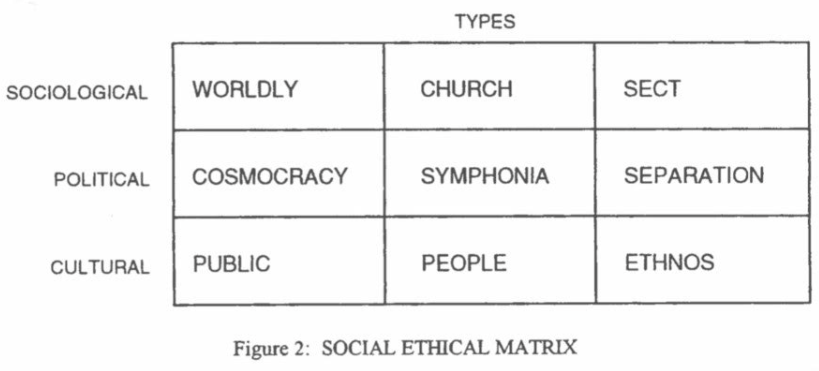
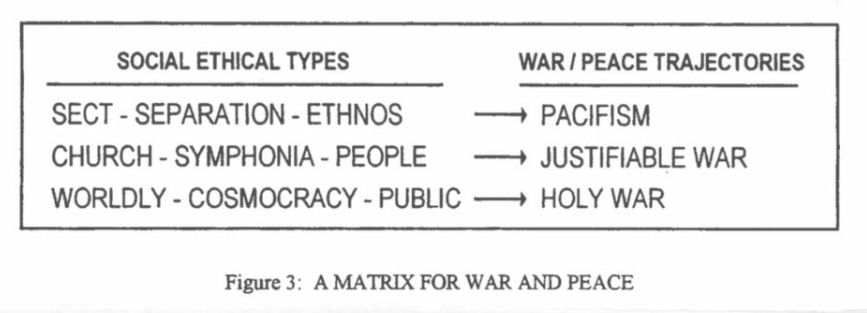
The first of these two typologies is what I call a “Social Ethical Matrix” (see the first accompanying chart). It provides a “macro” or global theoretical framework of ways that religious communities—particularly Christianity—might relate to the various concentric dimensions of public social, political, and cultural life ranging from accommodation to limited cooperation to separation. The second typology is a “Matrix for War and Peace” (see the second accompanying chart), which provides a “micro” or ideological application to specific ethical or moral “trajectories” of war and peace among nations.
The vertical column on the left side of the 9-box chart in the Social Ethical Matrix lists three major academic categories of human interaction in communities: sociological, political, and cultural—or in nominative form: society, government, and personal human interaction. The nine “types” in the three rows of boxes illustrate the intricate relations that obtain among all the types in each matrix. The types in each vertical column are closely related as moral approaches to the various concentric dimensions of social life. The left-hand column reflects a radically inclined choice toward accommodation to the secular world contra religion, while the right-hand column reflects a more anti-world outlook toward what its practitioners deem an irreligious or even anti-religious agenda, leading the neo-sectarians to withdraw as much as possible from government, culture, and society in general.
The middle vertical column contains the “mainstream” for an Eastern Orthodox social ethic, for example, insofar as it attempts a positive, antinomical resolution of the two opposing types on the margins, as it were.
First, the elevated “Church” type in the Sociological trajectory mediates between the more accommodationist and too often indifferent approach of the “Worldly” people of faith and the more “Sect”-like people of faith who wish to keep a good distance from society to avoid the risk of sin or even apostasy.
Second, the “Symphonia” type in the Political trajectory (see the middle column)—which I have derived from the history of Eastern Orthodoxy in the ancient Byzantine Empire concept mid-6th century—entails mutual respect and harmonious cooperation between the religious authorities (Patriarchs of the Church of Constantinople) and political authorities (Byzantine emperors and government) with neither institution attempting to dominate the other but, supposedly, acting as “an orchestra” (or symphony—hence the Greek symphonia) for the spiritual and material welfare of all the faithful of the Empire and the Church.
Many centuries later, the Russian Orthodox Church—from its inception in Kievan Rus in AD 988 through all the Russian tsars until St. Nicholas the Royal Passion-Bearer and Martyr was deposed by the atheistic Bolshevist Communists in AD 1917, and since then during the Soviet era until the Communist regime ended with a whimper in 1991, even to the present era under ex-Communist heads-of-state—has attempted to act in the same spirit ofsymphonia even when the state clearly dominated the Church. Nonetheless, I would contend that even that kind of symphonia, which often tilted more toward the state than the Church, was and still is preferable to the two other types in this trajectory.
The “Cosmocracy” alternative type in the first accompanying chart, which is derived from the ancient Greek word “kosmos” (or “world” in English), is most evident among secular human beings as well as supposedly religious folks who deem their faith as less important than living more harmoniously with their non-believing neighbors, coworkers, and family members. They prefer a worldly “go along and get along” way of life in the political and social order even at the cost of expressing and living in accordance with their political beliefs.
The other antipodal political trajectory on the right side of the first chart is “Separation,” which drives its advocates to non-participation in the political system including voting, holding public office, or enrolling their children in government schools.
Third, the “People” type in the Cultural trajectory requires that the Church walk a moral tightrope between identifying too easily with ethnic society in the modern state. A balance is possible, however, by focusing on both nations and citizenries as potential peoples of God—not so much institutions created by man—who are, after all, the object of God’s providence. However, the “Ethnos” type (Greek for “a body of men”) in the cultural matrix tends clannishly to exaggerate and celebrate group identity based on race, ethnicity, and nationality (in modern terminology) instead of exalting individual persons as the highest form of creation in “the image and likeness” of God. In sharp contrast the “Public” type in this trajectory extols civil society as the standard cultural organizing principle. It tends to defer to whatever political structure and ethnic mix happens to be found within the territorial limits of a given government. Citizenship is the highest combined cultural and social ethical value and is presumed to provide an adequate common identity for the people who claim it. The role of the Church, therefore, consists in fully supporting the civil authorities and civic culture for the sake of a broader world vision than mere ethnic nationalism can tolerate—even at the expense of the full freedom of the Church! Likewise for other religious communities such as Judaism, Islam, Buddhism. The risk to one’s religious identity and full freedom of expression, therefore, is to become a political, social, and cultural “melting pot” instead of a “salad bowl.”
III.
Now we refine and narrow our scope to the overarching substantive theme of this presentation by turning to the second accompanying chart: “A Matrix for War and Peace.”
The left side of this handout reprises the Social Ethical Types of the first chart by rearranging the nine types into three horizontal rows of three types: (1) Sect – Separation – Ethnos, (2) Church – Symphonia – People, and (3) Worldly – Cosmocracy – Public. Each of these rows of three is linked by an arrow pointing to the right side of the chart and to only one of the major moral / ethical public policies pertaining to global violence: (1) Pacifism – (2) Justifiable War and – (3) Holy War. Unlike the intricate design of the first student handout, this one, which builds on the first accompanying chart, is simple and streamlined.
- PACIFISM
The first troika of SECT – SEPARATION – ETHNOS leads inexorably to the ethical or moral ideology of absolute pacifism against all violence and wars under any circumstances without exception—a very high bar, indeed! Personal and / or collective peaceful rejection—and sometimes even non-violent resistance—may be licit and even necessary for the sake of one’s conscience and religious sensibility. Advocates may attempt to dissuade aggressors verbally and respectfully or by placing themselves peaceably between aggressors and those who are targeted, even if that leads to their own demise as martyrs. But they cannot and will not concede the spiritual value or virtue of respect for the life of all living human beings irrespective of their behavior.
The question of “conscientious objection” to some wars but not all requires special attention. Beginning in spring 1942, only several months after the notorious and unprovoked Japanese “sneak attack” on the US military bases in Hawaii—most notably Pearl Harbor—on December 7, 1941, and the entry of the United States into the Second World War as a combatant nation against the empire of Japan and the Nazi Third Reich in Germany, the US armed forces began to allow conscientious objectors (or COs in “military speak”) to serve in military uniform as unarmed medics without (1) engaging in offensive or defensive violence to save anyone’s life or (1) even bearing arms with “no intent” of using them under any circumstances including defense of their own lives!
An outstanding Hollywood film in 2016 titled “Hacksaw Ridge” introduced to American audiences the remarkable life of Desmond Doss (1919 to 2006). Born in Lynchburg, Virginia, Doss was an unassuming devout Seventh Day Adventist Protestant country boy who inspired the US military policy mentioned above. A committed pacifist who would never kill anyone under any circumstances or even bear arms or hold a weapon in his hands, Doss persuades his local Draft Board to allow him to join the US Army as a medic without bearing arms even for self-defense under any circumstances however dire. He tells the military board, “I thought that while other are taking lives, I could be saving lives. On the night of May 5, 1945, during the decisive Battler of Okinawa in the Pacific Theatre of World War II, Private First Class (PFC) Doss single-handedly saved the lives of some 75 wounded American marines—and tried to do the same for three gravely wounded Japanese soldiers! With a rope harness that he had rigged on the battlespace plateau at the top of a 120-foot cliff, he lowered painstakingly each one of them individually to safety under the cover of darkness—but occasionally under enemy fire—before his own rescue from the top of the cliff by his fellow soldiers in the morning.
On October 12, 1945, President Harry S. Truman awarded then Corporal Doss the Medal of Honor—the highest such recognition in the US armed forced—in a special ceremony on the White House lawn. Doss was the only conscientious objector awarded the Medal of Honor during World War II.
I suspect, alas, that many other hardcore religious pacifists who strongly reject the use of violence at all times in all circumstances would quietly disapprove of Doss’s heroic voluntary life-saving pacifist military service in combat areas without ever bearing or using arms as “hypocrisy” and even apostasy against the Sixth Commandment in the Bible: “Thou shalt not kill” (Exodus 20:13).
[Full Disclosure: I was a committed Orthodox religious pacifist for a dozen years until Iraq dropped approximately 42 modified Scud missiles on the Israeli cities of Tel Aviv and Haifa, Israel, between January 17 and February 23, 1991, for military purposes but also another, despicable reason: the concentration of Jewish survivors of the Holocaust in both cities. I concluded, reluctantly but firmly, that such monumental evil could be overcome in this life only by measured but decisive military means.]
- TOTAL War (including “Holy War”)
The third horizontal troika in my “Matrix for War and Peace” chart (WORLDLY – COSMOCRACY – PUBLIC) allows for and often celebrates a moral indifference toward the means to one’s end, because the end alone trumps all other possible considerations.
So called “Holy War” is the ancient and medieval precursor of the even more deadly secular version in our own era known as Total War. The brilliant Prussian general and military strategist Carl von Clausewitz introduced the concept of Total War beginning in the early nineteenth century. Both Holy War and Total War are, to say the least, extremely dubious from an Orthodox Christian moral perspective.
What appears to differentiate the “war ethic of the crusade,” as the Protestant theologian Edward LeRoy Long, Jr., labelled it in his book War and Conscience in America in 1968, from the “justifiable war” trajectory (which I shall discuss next) is the explicitly religious content and total lack of reasonable restraint. Long proposed four specific features: (1) religious motivation as the justification for military action; (2) the soldier’s task is esteemed often to the point of meriting “extrinsic religious rewards”; (3) an erosion of restraints against hostility toward the enemy; and (4) an absolutist spirit that mitigates discriminating judgements about involvement in war and conduct of war. Here is how David Little (then at the US Institute of Peace in Washington, DC) captured the extremism of this trajectory during an academic conference in 1991 that I attended: “Opponents in a holy war or crusade tend to regard each other as cosmic enemies with whom compromise is impossible.”
In short, Holy War (including religious Crusades such as the most notorious ones to regain Jerusalem and the Holy Land from the Muslim Arabs who conquered that region in AD 1095) inevitably entails a religious extremism that know no bounds for either means or ends. Though shrouded in religious language—for example, the medieval Christians’ call to battle” “Deus Vult!” or “God Wills It!” or the quasi-religious language of hateful and despicable modern ideological movements such German Nazism and Soviet & Chinese Communism—the unrestrained quality of this kind of human enterprise from time immemorial was described best as “total war” by the Prussian general and scholar Carl von Clausewitz in his magnum opus On War published posthumously in 1832.
The judgement of another classic strategist on this point cannot be gainsaid. In the Art of War, the seminal work that fueled the strategic thinking of both sides of the American Civil War from 1861 to 1865, Baron de Jomini opined, “Religious wars are above all the most deplorable.”
The history of my own Eastern Orthodox Church is, alas, checkered in this respect. For example, early in the fourth century the Greek bishop and historian Eusebios wrote a controversial encomium to St. Constantine the Great, the spectacularly successful warrior “Caesar” (or junior Emperor, as it were) from what is now Nis, Serbia, who battled his way up the Roman imperial hierarchy to become the first Christian Emperor in AD 325 in what eventually would be termed the Byzantine (or Eastern Roman) Empire. Eusebios exulted in the emperor’s military conquests and forcible conversions of those who “defied God”! As early as the fourth century, therefore, a uniquely Christian theological / spiritual foundation was laid for the forcible, offensive extension of the Church and Kingdom by the ostensibly Christian civil authority.
However, it is safe, in my estimation today, to discard the Holy War trajectory as non-normative in Eastern Orthodox moral tradition and practice. Religious so-called “holy wars” were—and still are where practiced today—anything but “holy.”
The second troika of CHURCH-SYMPHONIA-PEOPLE mediates between the two preceding typologies and is probably the most often invoked by nations and other groups today. Accordingly, it merits special attention alone in Part IV.
IV.
The third option in my Matrix for War and Peace, which mediates between the two moral and ethical antipodes examined in section III of this article—namely Absolute Pacifism and Nonviolence, on the one hand, and, on the other hand, the sheer brazen consequentialism of “Holy War” or absolute war—is the Justifiable War Tradition (or JWT) as advanced, in particular, by Professor Paul Ramsey at Princeton University in two seminal books during the Vietnam War era, no less! The first was War and the Christian Conscience: How Shall Modern War Be Conducted Justly? in 1961 and the second was Just War: Force and Responsibility in 1968. Both remain, in my estimation, the gold standard for this topic.
The JWT entails, above all, what we might call a “teleology of justice.” Like other forms of that moral or ethical perspective, JWT entails a proportionality of morally good (or, at least in some circumstances, “neutral”) means to morally good ends—that is, purposes, intentions, goals, or teloi in Greek). The internal debate within Orthodox Christian ecclesial circles (and perhaps also more widely in other religious and scholarly communities) concerns the crucial issue of means. Setting aside the views of the absolute pacifists, for whom any violence against human beings is precluded a priori, we may sharpen the question further to whether the resort to war for a good end is itself an evil or may be a good means to that end.
In his last epistle in the New Testament, the Apostle John provides a simple but crystal-clear moral prescription. In 3 John 11, he writes, “Beloved, do not imitate evil but imitate good. He who does good is of God; he who does evil has not seen God” (RSV).
The Apostle Paul provides three important parallels in what is arguably his greatest work. In Romans 12:17 he states unequivocally, “Repay no one evil for evil, but take thought for what is noble in sight of all” (RSV). A few verses later in Romans 12:21 he commands: “Do not be overcome by evil, but overcome evil with good” (RSV). The defining moment of St. Paul’s own teleological approach to morality occurs earlier in the same epistle. In Romans 3:8 the Apostle asks rhetorically, “And why not do evil that good may come?—as some people slanderously charge us with saying. Their condemnation is just” (RSV). The Honorable John Finnis, Australian-born Professor of Law and Legal Philosophy Emeritus at Oxford University and an esteemed Roman Catholic theologian, has dubbed that biblical rejection of evil means to good ends the “Pauline Principle.”
A sweep of patristic literature would fail to detect even one Church father who gives moral permission to commit an unmistakably evil act, “lesser” or otherwise. An intrinsic evil may be defined precisely as an unholy, unrighteous, or sinful act against God, another human being, or oneself, which, irrespective of the circumstances, intention, or anticipate consequences, may not be freely or knowingly chosen by anyone in good conscience.
The only Church father of the ancient Church to achieve celebrity status as an original thinker on issues of war and peace among contemporary Western religious and secular scholars is St. Augustine of Hippo (+ AD 430). The contribution of this Latin bishop in North Africa was indeed profound and need only be summarized here from a distinctively teleological Eastern Orthodox perspective.
St. Augustine’s fundamental ethic may be characterized as a “teleology of theocentric love,” as the Lutheran theologian George W. Forell first suggested in his book History of Christian Ethics in 1979. Intentionality is the decisive standard for ethical judgment according to the great Latin patristic theologian. St. Augustine redefines the ecclesial category of virtue (arete or “excellence” in Greek) in a distinctively Christian manner as “the perfect love of God,” the supreme good. He effects the transition from this teleology to the justification of some wars in his discussions on what modern jurists might term justifiable homicide in his magnum opus The City of God, a lesser treatise Against Faustus, and in several key letters.
St. Augustine defines justice and injustice in relation to the propriety of means to ends. Thus, in the wars conducted by Moses according to the Old Testament, the Hebrew prophet’s obedience to God’s providential commands determined their relative goodness. The salient point here, and throughout St. St. Augustine’s oeuvre, is the relativity of justice—hence Paul Ramsey’s astute preference for the neo-Augustinian term “justifiable war” in lieu of the more familiar “just war.” Human motives are usually quite mixed, and each of us is both a “saint” and a “sinner” (simul justus et peccator in St. Augustine’s felicitous Latin phrase). In no way does the great Latin bishop exult in the misery of war or soft-pedal its omnipresence in human history as the vanquished hope of peace on earth and a consequence of sin. The “wise man,” he avers, “if he remembers that he is a human being . . . will lament the fact that he is faced with the necessity of waging just war; for if they were not just, he would not have to engage in them, and consequently there would be no wars for a wise man. For it is the injustice of the opposing side that lays on the wise man the duty of waging wars.”
But victory in war providentially still goes to the “juster” side, and St. Augustine does not shrink from assigning the moral description of “good” to that result. He continues:
“Now when the victory goes to the those who were fighting for the juster cause, can anyone doubt that the victory is a matter of rejoicing and the resulting peace is something to be desired? Those things are goods and undoubtedly they are gifts of God.”
Another crucial element in St. Augustine’s teleological approach to the morality of war is the differentiation of “the interior disposition of the heart” from “the act which appears exteriorly.” A Christian as an individual person has no right to kill even in self-defense(!), because killing another person betrays a sinful interior attachment to one’s own transitory life that excludes loving the enemy for the sake if God! However, as a soldier of the community—which by St. Augustine’s time in the late fourth and early fifth centuries AD, was preeminently the Christianized Roman Empire—a Christian may kill. Such an outward act of obedience to divinely ordained political authority absolves the soldier of guilt and can be instrumental in assisting the enemy, in an act of other-regarding love, to “yield to their own welfare”! The only possible evil in a justifiable war is the sinful love of violence, cruelty, power, destruction, etc., that may still characterize the internal disposition of the individual soldier who fulfills, exteriorly, the mandate of “righteous retribution” to “correct or punish” the sins of the wicked against the community while pursuing an ordered, or just, peace as “the desired end of war.” Conversely, as long as the Christian soldier engages in combat and even the killing of enemy soldiers on proper authority and without internal rancor, he does not contravene the teleology of theocentric love but fulfills it by seeking and attaining retributive justice, a lesser virtue (in the Aristotelian ethical tradition) in service to the ultimate Christian virtue of love.
As influential as St. Augustine has proved in the Western world, his impact on Eastern Orthodoxy as opposed to the Roman Catholic and Protestant moral traditions has, alas, been minimal. Historically, my own religious tradition has relied much more heavily on the patristic patrimony of the Greek and middle eastern Church fathers. That is a needless problem that my own writing and teaching on this subject for fifty years has tried to overcome.
The medieval Roman Catholic saint Thomas Aquinas crystallized that fundamental biblical and patristic insight in his forceful argument in the magisterial Summa Theologiae (or “Highest Theology”) in the thirteenth century. The object of one’s moral decision (that is, the action that is chosen as the means to one’s end) must be morally good, or at least not intrinsically evil. How, then, may any Christian countenance a course of action—such as war—that he freely and knowingly concedes is “evil,” even if he allows that it is a “lesser” enormity than permitting, through inaction, an aggressor to subvert justice and wreak havoc among his or any people? If all war or any particular war is deemed an evil, a Christian nation or people may not elect to go to war even as a last resort. The logical contrapositive also holds. If a particular war can be justified morally, it must be a good act—or at least a morally neutral act, if such a thing is possible. Perhaps it is “lesser good” than diplomatic persuasion or nonviolent, nonresistant suffering in full imitation of the “higher” self-sacrificing love of Jesus Christ. But it is good nonetheless!
The key to the problem here is now to frame the moral decision properly—specifically, how to define accurately both the means and end in question. To the familiar refrain among anti-consequentialists that ends do not justify the means we might offer this flippant rejoinder: if the ends do not justify the means, at least in part, then what does! The act of cutting human flesh, for example, may be good or evil, depending on the identity of the agent (the person cutting), his intention, and, above all, how he goes about his business. An armed robber assaulting his victim with a switchblade obviously commits an intrinsically evil act, but a skilled cardiac surgeon operating on a patient in extremis may be engaged in a good act! To be sure, the immediate slicing of skin and muscle tissue and the cracking of ribs to get to the heart might, prima facie, appear to be cruel or “violent,” but it may also be the only way the surgeon can perform a life-saving operation. In addition, the good surgeon cuts and breaks only the bare minimum of human flesh and bones respectively, thereby safeguarding the life of the patient and treating the entire body with respect and the person with reverence.
In the admittedly much rarer cases when war may be justified in accordance with the jus ad bellum and jus in bello criteria of the Eastern Orthodox justifiable war trajectory elucidated above, the specific acts of harming, wounding, or killing enemy soldiers or terrorist must similarly be evaluated in the context of a “teleology of justice.” Orthodox Christian soldiers and other military personnel.
- Duly authorized by a legitimate political authority such as the Byzantine emperor or other Orthodox monarchs in the past or, currently, internationally recognized heads-of-state that do not pose an immediate threat to the Orthodox community or, to be sure, any other traditional religious community
- To defend and protect their Church or homeland from an unjust aggressor such as an invading force (whether a conventional military transgression of internationally recognized borders or lethal violence in the more contemporary form of international terrorism), and
- Who utilize minimal force in direct proportion to the clearly—in their own minds and expressed will of their constituency—intended restoration of the status quo ante (instead of conquest or other kinds of unwarranted aggrandizement),
- May, in good conscience, engage in warfare as a “lesser good” as long as that military activity targets the unjust aggressor instead of civilian noncombatants and is exercised with a minimum of necessary lethality and destruction.
Such limited and proportionate warfare in pursuit of just ends becomes a function of justice. Since justice is one of the four “cardinal” virtues introduced by Plato in ancient Greek, acknowledged in the Septuagint Old Testament in ancient Greek (Wisdom 8:7), and amplified through the entire patristic tradition, justice in war—both as an end and the means to that end—may also be virtuous and, hence, morally good. This is the ineluctable conclusion that we must acknowledge. Whenever the Holy Scriptures, Church fathers, canons, lives of the saints, liturgical texts and hymnography, and modern theologians and literary authors speak of military activity in terms of right or righteousness, nobility, valor, or heroism, their individual and collective impact alike is the same: a justification of such human activity as a moral good and the soldiers and other military personnel who carry it out as virtuous warriors.
This highly constrained use of armed might—which is even more limited in scope than the secular “just war theory” as it is currently enunciated by many Roman Catholic or Protestant Christians—offers a stark, sobering contrast to the ideology of international Islamic terrorism today. The latter promotes the conscious, deliberate targeting of innocent civilians and a maximum of destruction and disorder as a matter of preference, no less!—to inspire fear and terror among the masses that might weaken their resolve and pave the way for eventual Islamist takeover. Those extremists do not act reluctantly or with a troubled conscience. Instead, they rejoice and exult in evil means to supposedly “good” ends.
The stakes for Western Civilization could not be higher. The Eastern Orthodox “justifiable war tradition” is obviously needed now more than ever.
V.
The 20th century was, alas, marked by the most violent world wars and mass destruction in human history. We in the 21st century can still reverse that unhappy and unholy trend. By the grace of Almighty God, there is still time for us to do so.
“Perchance to dream!”
About the author

Archpriest Alexander F. C. Webster, Ph.D., retired in August 2019 as Dean and Professor of Moral Theology Emeritus at Holy Trinity Orthodox Seminary in Jordanville, New York. He also retired in June 2010 as a U.S. Army chaplain in the rank of Colonel after a quarter century of service in uniform, his last five years back on active duty primarily to conduct twelve periodic visits to the American and Coalition troops of Eastern Orthodox Christian faith in the combat areas of Afghanistan and Iraq, as well as Kuwait and Qatar. Archpriest Alexander holds academic degrees in History from the University of Pennsylvania (A.B., 1972), History & Education from Columbia University (M.A., 1975), Theology from Harvard University Divinity School (M.T.S.,1977), and Religion / Social Ethics from the University of Pittsburgh (Ph.D., 1988). In addition to 50 scholarly articles and book chapters, as well as more than 100 op-ed articles and interviews in newspapers, magazines, and online, he is the author of five books on religious ethical themes and co-editor and contributor of two more books. Following ordination to the Holy Priesthood in September 1982, he served for a total of 26 years as rector of Orthodox parishes in Clairton, PA, Falls Church, VA, and Stafford, VA. Currently an adjunct professor of Religious Studies at George Mason University, Archpriest Alexander has also taught at eleven institutions of higher education including George Washington University, Virginia Theological Seminary, and the University of Maryland University College in Okinawa, Japan. He has been married for 53 years to Matushka Kathleen, and they are blessed with four children and three grandchildren.